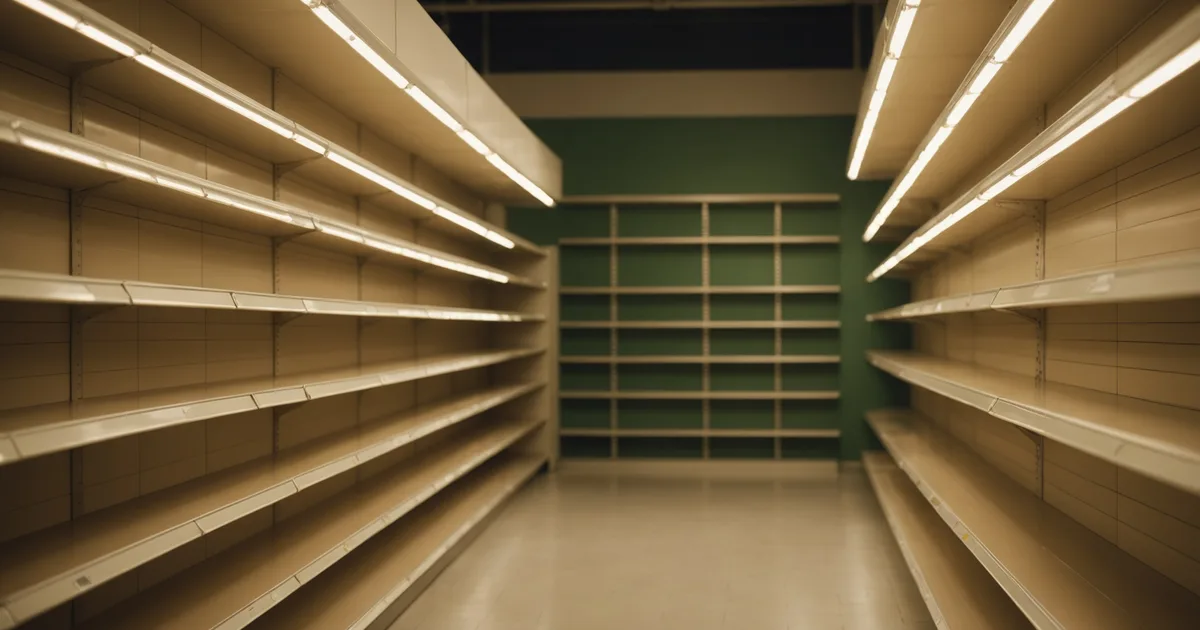
Saturday afternoon is the highest-revenue window of the week for most independent food and specialty retail stores. Foot traffic is up, basket sizes tend to be larger, and customers who discovered your store on a weekday return with a purpose. It's the window that justifies the rent, the payroll, the refrigeration costs. And it's the window when a stockout on a fast-moving product does the most damage.
The immediate cost of a weekend stockout is easy to see: a customer wants the product, the shelf is empty, they leave without buying it. One lost sale. What's harder to see is everything that happens after that moment -- and those downstream costs are often significantly larger than the face value of the lost transaction.
The Customer Behavior Cost
Retail customer loyalty is built on reliability. A customer who shops your store regularly does so because they've learned they can depend on you for the products they want, when they want them. A stockout violates that expectation -- not dramatically, but incrementally. The first time it happens, they're mildly annoyed and probably still come back. The second or third time it happens on the same product, they start adjusting their behavior.
The adjustment usually looks like one of three things: they add the product to their order from a different channel (grocery delivery, another store's online shop), they substitute with a different brand permanently, or they start shopping your store less frequently and split their spend with a competitor who stocks the item more reliably. None of these adjustments are visible in your POS data. They show up only as a slow erosion in that customer's average visit frequency or basket size over the following months.
For independent retailers who depend on a customer base of regulars -- buyers who come in two or three times a week, who know the staff, who recommend the store to friends -- that erosion is serious. You're not losing one transaction. You're losing a fraction of a high-value repeat customer's lifetime spend.
The Substitution Trap
Some stockouts result in a substitution sale rather than a lost sale: the customer takes the next best option. This can look good in aggregate sales data -- units sold didn't drop much -- but it masks a real problem.
First, the substitute may have lower margin than the item the customer wanted. If a customer comes in for your highest-margin organic oat milk SKU and leaves with a conventional brand because you're out, you sold something but you didn't sell the thing your purchasing decisions were optimized around.
Second, substitution data can mislead your next buying decision. If the substitute product sold well during the weekend you were out of the original, that may look like genuine demand for the substitute rather than emergency substitution. You order more of the substitute at your next replenishment cycle while the original item is still undersupplied -- because your reorder point is based on average sales, not on the artificially suppressed sales caused by the stockout.
Stockouts corrupt your demand signal. This is one of the least discussed costs and one of the most consequential for forecasting accuracy over time.
The Earned Distrust Effect
There's a second-order customer behavior change that's even harder to measure: customers stop trusting that you'll have what they need on peak days. They start calling ahead before making a trip. They buy extra when they find the item in stock because they've learned they can't count on it being there next time. They stop recommending the store to friends for that category.
This distrust is rational on the customer's part and devastating for the retailer. A store where customers pre-emptively over-buy because they've learned it stockouts regularly is a store with an inflated sales pattern that will eventually normalize downward as some customers give up on the category entirely at your location.
The Supplier Relationship Cost
Weekend stockouts on high-velocity SKUs often trigger urgent reorder calls on Monday morning. Those calls come with costs: expedited freight charges from some suppliers, the need to meet a higher minimum order quantity than your actual short-term need justifies, and the buyer's time spent on reactive purchasing that should have been predictive.
Over time, a pattern of urgent orders can affect your standing with key suppliers. Vendors who see your account generating irregular, reactive orders may prioritize more predictable customers for allocation when supply is tight -- exactly the opposite of what you need when you're already experiencing stockouts. The buyer who places consistent, well-sized orders on a regular cadence is the buyer who gets reliable service. The buyer who panics on Monday morning is the one who gets put in the queue.
Quantifying the Real Cost
A useful exercise for any multi-store buyer is to calculate what weekend stockouts actually cost, fully loaded. Start with direct lost sales: units you would have sold if the shelf had been stocked, multiplied by the retail price. Then apply a churn factor for high-value repeat customers who reduce visit frequency after repeated stockouts on their preferred items. Then add the emergency freight premium on reactive orders. Then account for the buyer hours spent on Monday-morning order placement instead of category management.
When buyers at independent multi-location chains work through this calculation carefully, the number is typically well above what feels intuitive. A single SKU out of stock for two days on a weekend at a single high-velocity location is not a $50 problem. It's a $200-800 problem once you account for the full cascade, depending on the product and the customer (based on internal pilot store tracking, 2025).
Prevention Is Far Cheaper Than Recovery
The structural solution to weekend stockouts is not heroic effort on Monday morning. It's an accurate weekly forecast that accounts for the day-of-week velocity pattern -- specifically the Friday-through-Sunday spike that characterizes most high-traffic retail categories -- and triggers a replenishment order that has the product on the shelf by Friday morning.
This requires knowing, for each store independently, what sell-through rate to expect from Thursday through Sunday, and making sure the on-hand count on Wednesday is high enough to cover that window plus a safety margin. It requires that forecast to be current -- not based on a quarterly average, but on actual recent velocity. And it requires the replenishment order to be generated early enough in the week that the supplier can fulfill it before the weekend window opens.
None of this is complicated in theory. Getting it to happen systematically, across multiple locations, every week, without manual intervention is the operational challenge that most buyers in multi-store retail are still solving by hand -- and getting wrong often enough that weekend stockouts remain a routine cost rather than a solved problem.