The reorder point formula has been a fixture of retail inventory management for decades. You calculate average daily demand, multiply by your lead time in days, add a safety stock buffer, and set the trigger. When on-hand inventory drops to that number, you place a new order. Clean. Logical. Completely suited to an era when a buyer managed one location, one supplier lead time, and one demand pattern.
Multi-store retail didn't exist at scale when that formula became standard practice. And the formula was never updated to account for what actually happens when you run five locations in different neighborhoods, or twelve stores across three cities.
The Timescale Problem
Reorder points are typically set during a quarterly or semi-annual buying review. A buyer looks at historical sales data, calculates average velocity, and sets the trigger for the next period. This process is reasonable if demand is stable and the review cycle is tight. In practice, neither condition holds for most retailers.
Demand shifts weekly. A product that sold 14 units per week in January might sell 30 units per week in March because a competitor ran out of stock, because a local influencer mentioned it, because the weather changed, or because one of your locations started stocking it near the register instead of on a back shelf. None of those events appear in a quarterly average. The reorder point calculated in January still says 14.
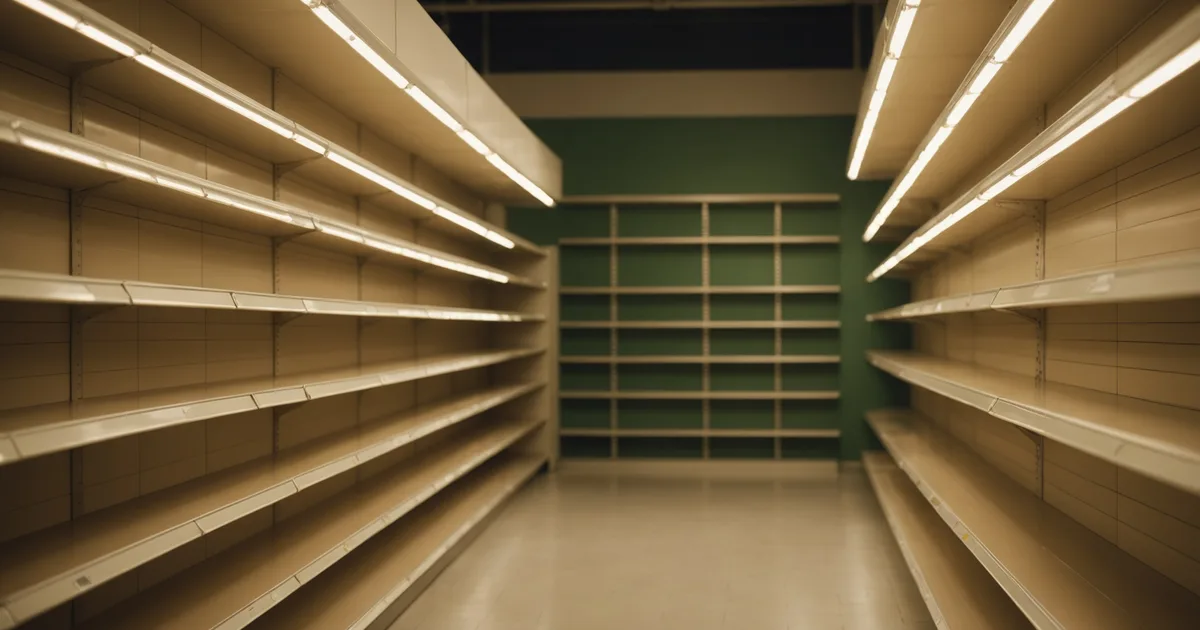
The result: you order based on January's velocity, but you're living in March's reality. The reorder trigger fires too late, or not at all, and the shelf goes empty on the Saturday it actually matters.
The Multi-Location Compounding Effect
For a single-location buyer, a stale reorder point is painful but manageable. You notice the problem, you fix it manually, and you update your spreadsheet. The feedback loop is short.
Add four more locations and the feedback loop breaks down. Each store has its own demand pattern. Your Uptown location might sell 22 units of a product per week while your South Side location sells 8. They're in the same city selling the same product, but the neighborhoods are different, the customer base is different, the foot traffic patterns are different. If you set a chain-wide reorder point based on the average -- 15 units -- you're perpetually under-ordering for Uptown and over-ordering for South Side.
Over-ordering for South Side creates a carrying cost problem. Under-ordering for Uptown creates a stockout problem. Both are real costs. The reorder point formula, applied at the chain level, creates both simultaneously.
Why Averaging Makes It Worse
The instinct when managing multiple locations is to aggregate. You pull total sales across all stores, calculate a single reorder point, and set a chain-wide policy. This feels efficient because it is efficient -- for the buyer. It is not efficient for inventory performance.
Aggregation hides the signal. If Location A sells 30 units per week and Location B sells 6 units per week, the chain average is 18 units per week. The reorder point is built on 18. But Location A is hitting its actual stockout risk at 24 units on hand, and Location B has excess at any quantity above 10 units. The average tells you neither of these things.
The only safe response to this uncertainty is inflated safety stock -- which ties up capital and increases carrying costs -- or frequent manual overrides -- which is exactly the kind of buyer time that should be spent on higher-value decisions.
The Monday Morning Pattern
Most buyers who manage multi-store chains recognize this pattern intuitively, even if they haven't named it. Monday morning arrives. Someone on the floor calls in that Location C ran out of the fast-moving oat milk SKU over the weekend. The buyer pulls up their spreadsheet, checks the other locations, realizes two more are under their safety stock threshold, and spends the first two hours of the week placing emergency top-up orders.
This is not a process failure. This is a structural failure. The reorder point system doesn't surface these situations in advance because it wasn't designed to watch multiple locations at weekly velocity granularity. It was designed to watch one location on a quarterly review cycle.
The emergency order has a real cost beyond the buyer's time. Rush orders often come with higher freight costs. Supplier minimums may require you to order more than you need at one location to meet the threshold. And the stockout itself -- even if it lasted only one or two days -- already happened during your peak window.
What the Formula Actually Needs
A reorder point that works for a multi-store retailer in 2026 needs to do three things that the classic formula doesn't do.
First, it needs to calculate per location, not per chain. The Uptown store and the South Side store need separate reorder points based on their separate demand histories and their separate velocity trends. An aggregate calculation erases the information that matters most.
Second, it needs to update continuously, not quarterly. Demand changes between your buying reviews. A system that only sees demand at the quarterly checkpoint is operating on stale data for most of the year. Velocity from the last four to eight weeks is far more predictive than velocity from the last twelve months.
Third, it needs to account for the day-of-week pattern that matters to retail specifically. A product that sells 8 units Monday through Friday and 22 units Saturday and Sunday has a completely different stockout risk profile than its weekly average of about 12 units per day suggests. If your Thursday on-hand count is 15 units and you're forecasting based on 12 units per day, you think you're fine. You're not. You're going to run out Saturday afternoon.
The Real Cost of Getting This Wrong
Industry surveys of independent multi-location retailers consistently find that stockout rates are highest on weekends and highest on fast-moving, frequently replenished SKUs -- precisely because those are the items where demand velocity is highest and the gap between the last reorder point calculation and current reality is widest (based on buyer interview data compiled through 2025).
A weekend stockout on a staple product like organic oat milk or a top-selling cold brew SKU doesn't just lose one sale. It changes customer behavior. Customers who can't find what they came for learn to call ahead, buy less, or go elsewhere. For a 5-location independent chain competing with well-stocked regional chains, that behavioral change is a real competitive problem.
The good news is that this is a solvable problem -- not through more complex spreadsheets, but through a system that calculates demand at the store level and updates those calculations continuously from actual sell-through data. The reorder point concept itself isn't wrong; the timescale and granularity at which it's applied has just never caught up with what multi-store retail actually looks like.
Getting the replenishment trigger right -- per store, per week, based on actual velocity -- is the single highest-leverage inventory improvement most multi-location buyers can make. Everything downstream (order size, supplier timing, carrying cost) improves when the trigger is accurate.